Smokeball
Established and scaled product design within a high-growth SaaS business, aligning product, CX and engineering around more insight-led, outcome-driven decision-making and laying the foundations for AI-enabled product experiences.
The Problem
When I joined Smokeball in 2023, the product had scaled to US$50M ARR through a founder- and engineering-led approach, with no dedicated design function. The experience had evolved organically, resulting in inconsistency across workflows and a lack of a cohesive, intentional product experience.
Smokeball had recognised that competing with larger, better-resourced players required a step change in product, design, and go-to-market maturity—shifting toward a more structured, insight-led and scalable product organisation.
Customer insight existed, but wasn’t consistently shaping decisions, and rising expectations around usability, workflow efficiency, and AI made the need for change urgent.
Key Challenges
Navigating team change while maintaining trust.
Shifting from feature-led to insight-driven ways of working.
Elevating design as an equal partner.
Balancing transformation with delivery while building the team.
Approach
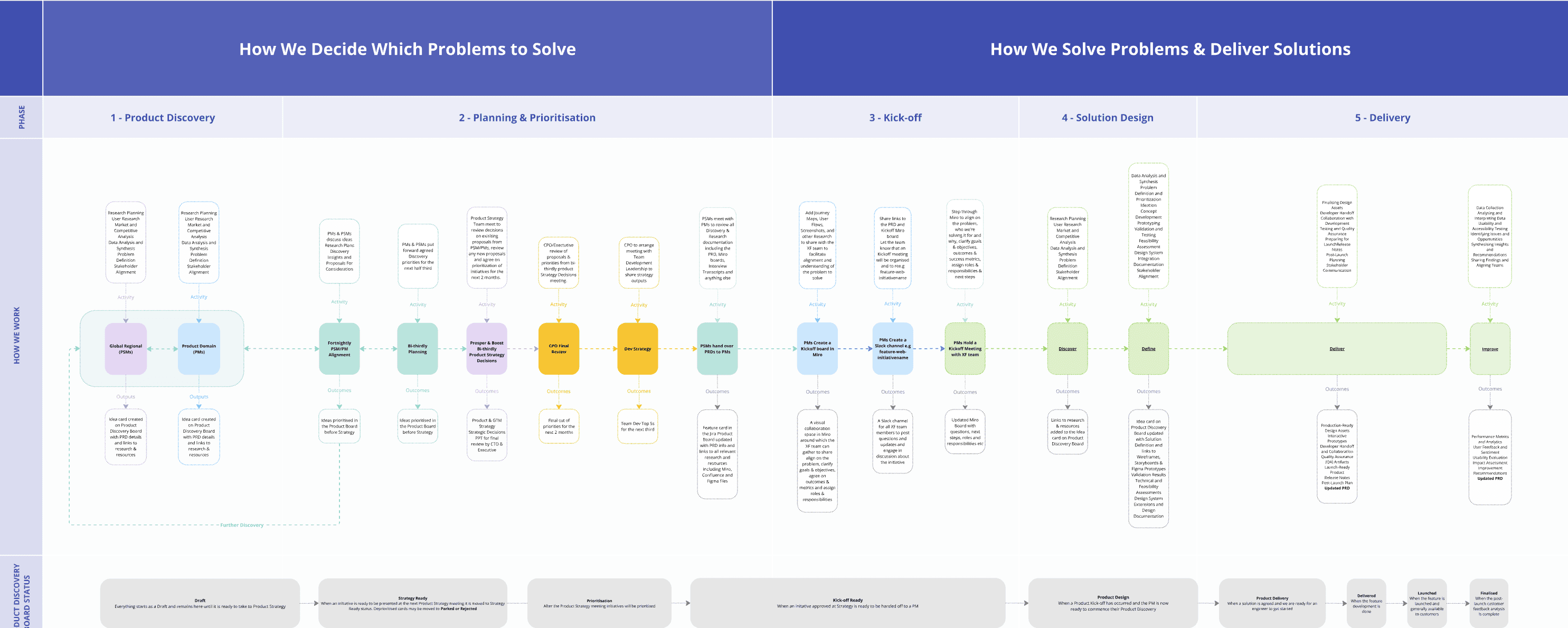
1. Establishing a balanced product operating model
Partnered with the CPO to redesign the product organisation and shift toward a more outcome-focused model.
Evolved the “two-in-a-box” (Product Owner + Engineering) into a “three-in-a-box” model (Product Management, Product Design, Engineering)
Positioned design as an equal partner in shaping product direction and delivery
Transitioned existing Product Owners into a dedicated Product Delivery function
Introduced Product Managers to drive strategy and customer outcomes
Temporarily led Product Management while establishing the function and preparing for future leadership
2. Building design and product capability
Defined new roles, created job descriptions and hired Product Designers and Product Managers
Established design practices, rituals and ways of working
Introduced more structured discovery and user-centred design approaches
3. Connecting customer insight to decision-making
Partnered with Customer Experience and Support teams to strengthen feedback loops
Improved visibility and accessibility of customer insight across product teams
Explored tools (e.g. Twine) to transform large volumes of customer conversations into more usable, scalable insight
4. Introducing AI into the product experience
Led design of AI-powered product experiences (including Archie)
Explored how AI could support customer workflows and improve productivity
Balanced opportunity with the realities of delivery, adoption and team capacity
5. Aligning cross-functional teams
Over time, aligned:
Product Design
Engineering
Product Delivery
Product Marketing
Customer Experience
Customer Support
Creating more integrated, end-to-end ways of working across the organisation.
My Role
Owned | Led | Contributed to |
|---|---|---|
|
|
|
Outcomes
Clarified ownership across product, design and engineering
Improved cross-functional collaboration and alignment
Shifted toward more insight-led, outcome-driven product decision-making
Increased visibility and use of customer insight across teams
Established the foundations for a scalable, design-led and AI-enabled product organisation
Embedding design, product and engineering as equal partners, supported by real customer insight, is critical to delivering consistent, high-quality experiences.